
anyformat Studio: Complex Document Workflows, No Complexity
Studio is the canvas where document intelligence pipelines become visible, composable, and accountable. Today it's live, and this is what it changes.
Most document intelligence tools are black boxes. You upload a document, you get structured data back, and somewhere in between something happens that nobody at your company can fully explain. When the output is right, that's fine. When it's wrong, you have a problem you cannot debug, cannot audit, and cannot put in front of a compliance officer with a straight face.
The pipeline is invisible, and that is harder to talk about than it sounds, because invisibility looks like plumbing. But at enterprise scale, the plumbing is the product. A document intelligence platform that cannot explain what it did to a document is, in the strict sense, indefensible. It does not survive an incident review. It does not survive an audit. It does not survive the operations lead asking why this one routed to manual review and that one did not.
Today we are shipping anyformat Studio. Studio is the visual layer where the pipeline becomes visible. Every step, every branch, every result, on a canvas you can read.
What Studio is
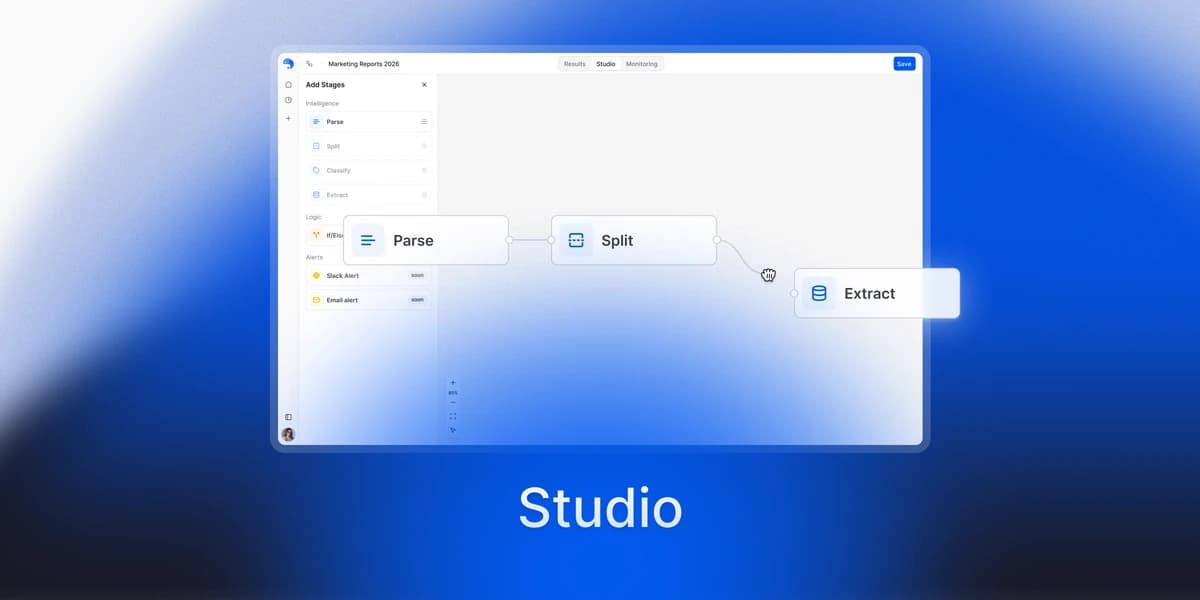
Studio is the visual interface for composing document intelligence workflows. A workflow is a directed graph of operators. Each operator is a discrete processing step, and each step has a defined input and a defined output. You do not write code to wire them together. You drag them onto a canvas and connect them.
Here is what that feels like in practice. You drop a Parse node onto the canvas to turn a raw document into structured pages. You connect it to a Classify node that routes by document type. You add an If/Else node that branches on the classification result. On one branch, you wire an Extract node that pulls structured fields against one schema. On the other branch, you wire a different Extract node configured for a different schema. Then you wire a Slack alert that fires whenever the confidence score drops below the threshold you set. That is a five-stage pipeline with a conditional branch and an outbound integration. Building it takes minutes.
The canvas is not a skin on top of the API. The workflow you build in Studio is the same workflow the API executes. One definition, two interfaces. A team can prototype on the canvas, then call the same workflow from a service, then come back to the canvas when the schema changes. Nothing has to be re-wired in two places, because there is only one place.
Monitoring is built in. Every execution is logged. Every operator's input and output is traceable. This is the same architecture that earned anyformat its ISO 27001:2022 certification, surfaced for the people who need to use it.
Why this matters at enterprise scale
Document processing inside an enterprise is not a batch job you fire and forget. It is an operational system that runs continuously, processes content that is often regulated, and feeds downstream business processes other people depend on. The volume is real. The stakes are real. The need to change the system without breaking it is real.
Three different people need to understand that system, and they almost never share a vocabulary. The engineer who built it thinks in code paths. The operations lead who owns it thinks in throughput and exceptions. The compliance officer who audits it thinks in evidence and provenance. Today, those three people are usually staring at three different artifacts, none of which fully agree.
Studio gives them a shared surface. The workflow on the canvas is what the engineer wired, what the operations lead reviews when something looks off, and what the compliance officer points to when the auditor asks how a sensitive field made it from a raw scan into a structured database. The graph is the system, and the system is what runs.
That shift is the difference between a tool and infrastructure. Tools solve a task. Infrastructure is something other people build on. Studio is built so that the people who run the operation can read it, change it, and prove it works, without translating between three different mental models of what the platform does underneath.
Composability is the architecture, not a feature
The reason Studio can make complex pipelines feel simple is that the underlying primitives were designed to compose. anyformat is built around four canonical concepts: operators, workflows, documents, and pages. Studio is the visual expression of operators and workflows. It is not a separate product. It is a different lens on the same system.
Operators are stateless, typed, and chainable. The output type of one operator either matches the input type of the next or it does not, and Studio tells you immediately. The graph you draw is the execution plan that runs at the platform level. There is no hidden YAML, no translation layer between what you see and what executes. What you wire is what runs.
When a workflow runs, every stage produces an intermediate result. Studio surfaces those results. You can see exactly where a document was parsed, how it was classified, what was extracted, and what triggered an alert. Debugging is no longer "check the logs and reconstruct the run." It is "click the node and read what came in, what went out, and what happened in between."
This is what makes document intelligence auditable in the way that matters. Not a checkbox attached to a certificate. Step-by-step traceability from source document to structured output, surfaced at exactly the point a human needs to look.
What we built
Studio is live today. It is the interface anyformat was always building toward, and the reason we have spent years getting the underlying abstractions right. Operators that compose. Workflows that execute deterministically. Documents and pages as first-class objects. A platform where complex, multi-stage document intelligence is not hidden inside configuration files or buried in API calls, but visible on a canvas, composable from simple primitives, and accountable at every step.
The hard architectural decisions are the ones that pay off years later, in the form of a product that does not need to apologize for itself. Studio is what those decisions look like when they ship. We are proud of how it landed, and we think it matters.