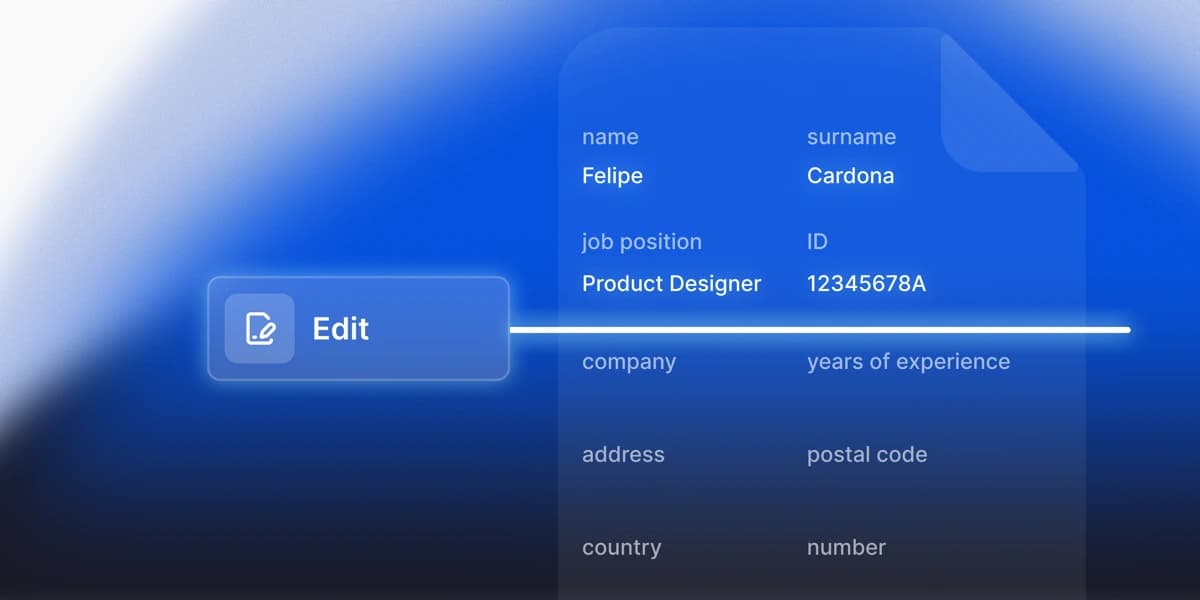

Edit: Filled Forms, Without the Field Mapping
Document intelligence has always run in one direction: documents in, data out. Edit is the operator that writes back. Hand a workflow a blank form and get the completed PDF, with every field detected for you and nothing mapped by hand.
This industry, anyformat included, was built around one direction of travel. Unstructured documents go in, structured data comes out. That direction is where the hard problems live, and it is where we spend most of our engineering hours.
But follow a real back-office process to the end and you often find the opposite problem waiting there. The process does not finish with a JSON object. It finishes with a form. A supplier onboarding packet from a new customer. A bank's KYC questionnaire. An insurer's claim form. A public administration's application, in whatever layout that administration decided on. The data needed to answer it is already clean and structured, sitting in the ERP or the CRM. And someone still spends the afternoon copying it into a PDF, field by field, for the fourth counterparty this month.
We spent years building machines that read documents so people would not have to. The last step of the process is still a person writing one.
Why form filling never got solved properly
The manual version everyone knows. The same answers, retyped into every counterparty's own layout: legal name, tax ID, IBAN, the same three contacts. It is slow, it is error-prone in the way all transcription is error-prone, and the error surface is the worst kind, because a transposed digit in a bank account field is invisible until money moves to the wrong place.
The traditional automation is template-based. Open the form in a design tool, mark the coordinates of every field, store the template, fill it programmatically. It works, under one condition: that you control the form. The forms a company is asked to fill are, almost by definition, other people's forms. Every counterparty sends its own layout. Layouts change without notice. A template built against version 3 of a form breaks silently on version 4. Template mapping means doing the setup work again for every counterparty, and again every time one of them redesigns a page.
Pasting the form into a chat assistant does not solve it either. A language model can tell you what to write. It cannot hand you back the counterparty's own PDF with the answers sitting in the right boxes.
Edit: hand it the form, get it back filled
Edit is a new operator in the anyformat platform. It takes the blank form it is given and returns the completed PDF. The property that matters is where the fields come from: Edit reads them off the document itself. You map nothing by hand.
It runs right after Parse. Parse reads the page and detects the structure, which for a form means the field geometry: labels, gaps, checkboxes, boxed grids, the underlined blank after "Legal name". Edit takes those detected fields, matches your data against them, and writes the values into the document. Because the fields are read from the form itself, a layout the workflow has never seen is handled the same way as one it has processed a hundred times. There is no template to build, so there is no template to break.
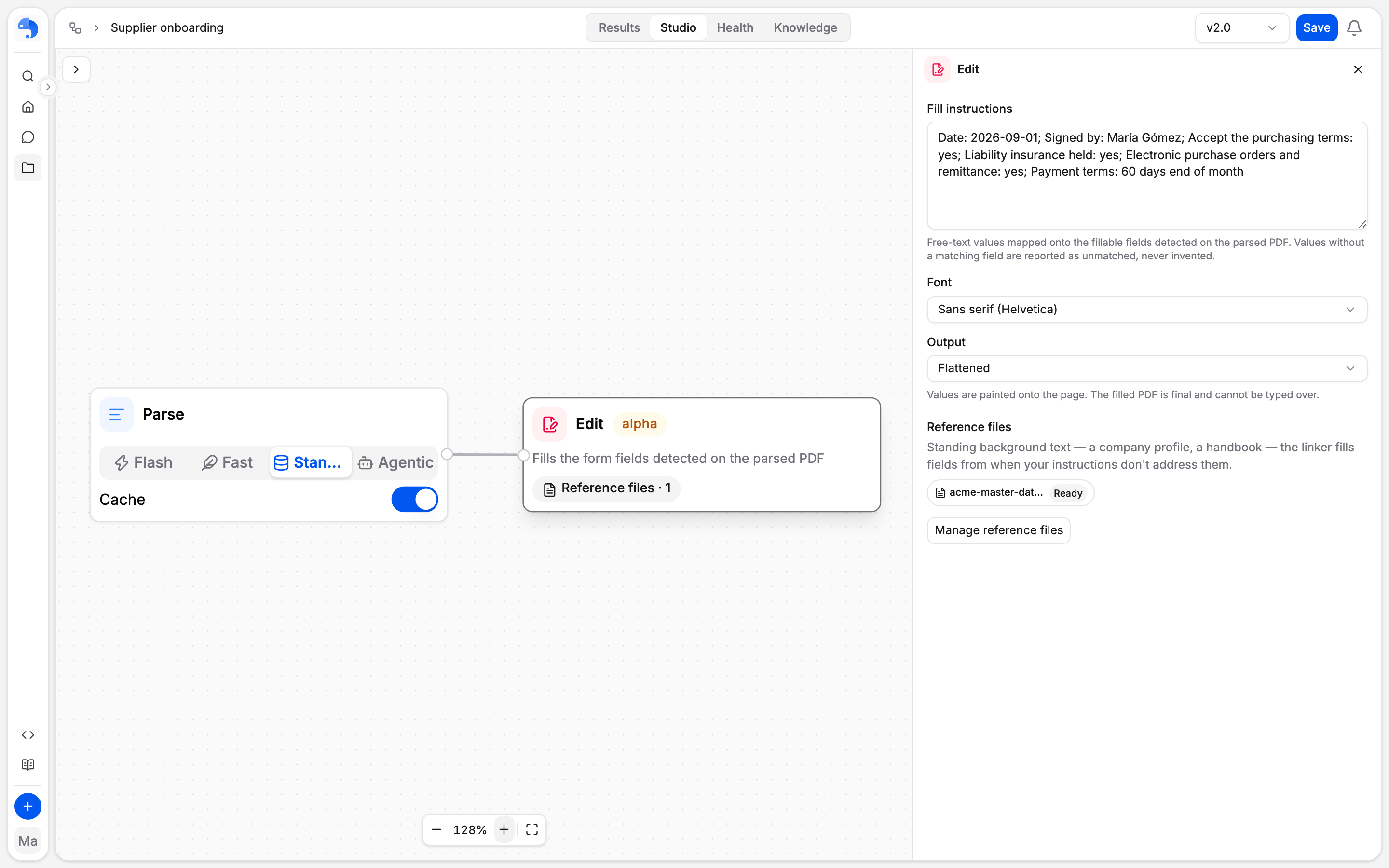
The values come from two places. Free-text instructions cover the per-run data: "Name: ACME SL; Date: 2026-09-01; I accept the terms: yes". Reference documents cover the standing data: upload the company's master data once, as CSV, plain text, Markdown or even another PDF, and every subsequent run reads from it. When both sources answer the same field, the instruction wins. That is the entire precedence model.
Supplier onboarding, start to finish
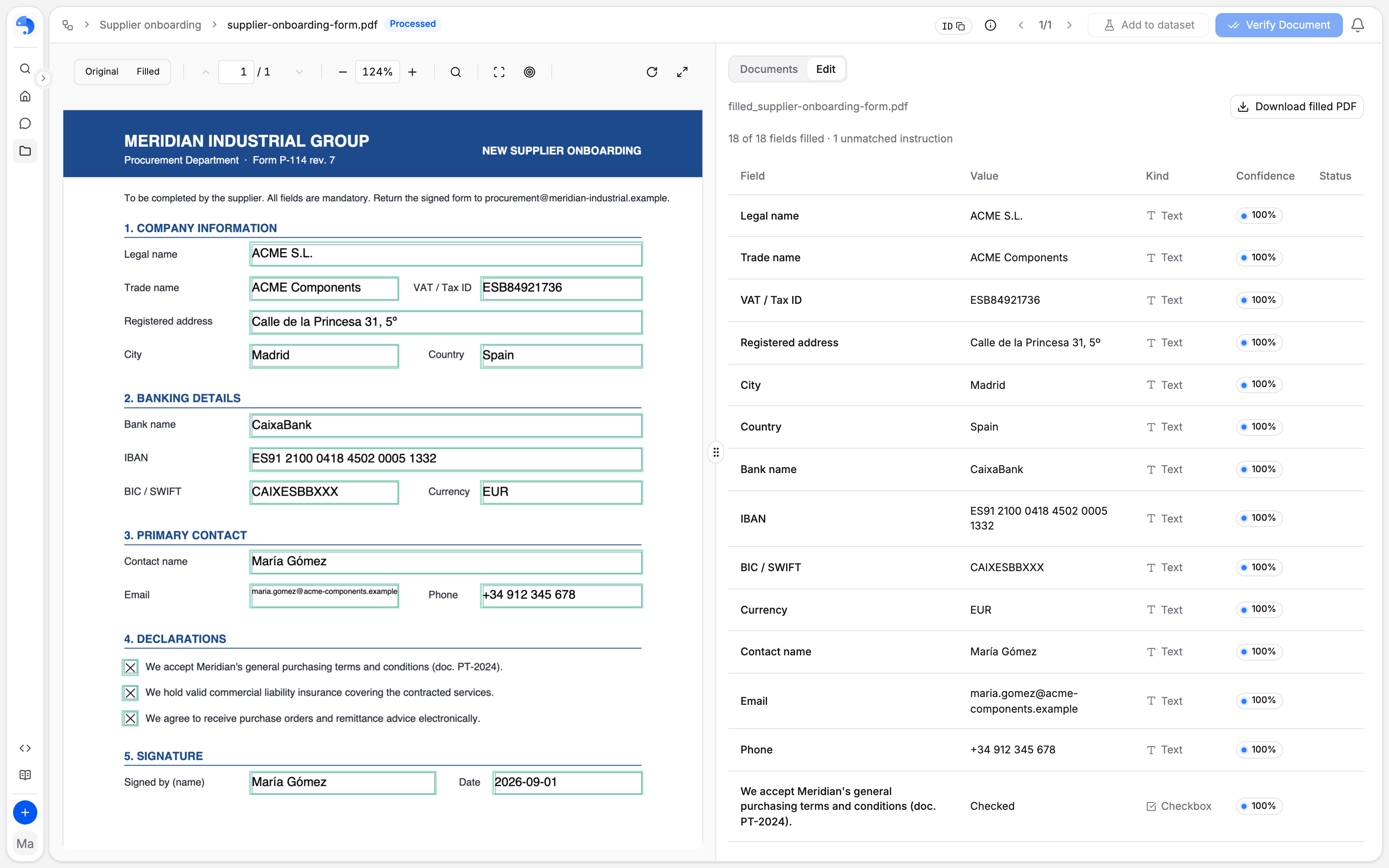
The concrete case this was built for is the one from the paragraph above. A company wins a new customer, and the customer sends its own supplier onboarding form. The answers never change: legal name, tax ID, bank details, contacts, insurance certificates. The layouts always do.
With Edit, the workflow is two operators: Parse, then Edit. The company's standing data goes in once, as reference documents. From then on, every blank form that arrives goes through the workflow and comes back completed. When a new customer shows up next quarter with a form nobody has seen before, there is nothing to reconfigure. The fields are read off the new form exactly as they were read off the last one.
An output you can check, not one you have to trust
The output of Edit is a PDF, not a JSON object. But it ships with a structured record of everything that was done to produce it.
Every detected field comes back with its label, the value written into it, and a confidence score. Fields that arrived already filled are detected as prefilled and left untouched. And instructions that matched no field on the form are not dropped silently: they come back in an explicit unmatched list, so "the form had no field for that" is a fact you learn from the run result, not from the counterparty three weeks later.
The output itself comes in two modes. Flattened, for documents that are final. Or editable, which keeps the form fields live, so a reviewer can correct any value in a normal PDF viewer before the document goes out. It is the same stance the rest of the platform takes: the system tells you what it did and how sure it is, and leaves the doubtful cases to a person instead of hiding them.
Documents in, documents out
Until now, the platform turned documents into data. With Edit, it also turns data into documents. The loop closes inside the same workflow system as everything else, with the same execution model, the same run results, and the same auditability. Extraction can feed it: the data pulled out of one document can be written into another, in one workflow.
The cost is the published per-page pricing, nothing exotic. Parse at 25 credits per page plus Edit at 35, so 60 credits per page for the full workflow. Text reference documents are free, and a PDF reference is parsed once at upload and never billed again.
Edit is live in the anyformat platform today. The documentation covers the operator in detail, and the fill-a-blank-form example is the two-operator workflow described above, ready to copy.
anyformat is the document intelligence platform that turns unstructured documents into reliable, structured data, with enterprise-grade security, confidence scoring, and full auditability. Learn more at anyformat.ai.